Introduction:
Before engaging on a discussion on the social construction of a hacker, the first question we must ask ourselves is, what exactly is a hacker? The Jargon file, a collection of hacker slang derived from technical cultures such as the MIT AI Lab, defines a hacker as 'A person who enjoys exploring the details of programmable systems and stretching their capabilities, as opposed to most users, who prefer to learn only the minimum necessary.' We shall see that a hacker as several other distinguishing qualities in addition to these. We explore the hacker ethic through a view of the life of Adrian Lamo, listed second in the top 10 hackers of all time by the CIA.
The Homeless Hacker:
Born in Boston, Massachusetts, Lamo gained widespread notoriety after breaking into the internal computer network of The New York Times, adding his name to the internal database of known sources and conducting research on its high profile subjects. Two years and a lawsuit later, he was convicted and sentenced to two years of probation along with a large amount of money in damages. Within this time, he had already gained popularity in hacker circles for gaining access to restricted areas in the Microsoft, Yahoo and WorldCom servers. Dubbed the 'homeless hacker', he used Internet connections at hotels, coffee shops and libraries to perform his intrusions. Lamo is a typical example of a hacker, someone who tries to stretch the limits and explore the capabilites of a computer system. He would fall into the black hat category - someone who uses his knowledge for nefarious and destrucive purposes. Nowadays, hackers tend to disassociate themselves from these people, instead referring to them as 'crackers'. So what do hackers gain from their exploitation and breaking in to computer systems?
Social Construction of the hacker:
Accorinding to Bryan Pfaffenberger in his article on the 'Social Meaning of the Personal Computer' tries to explain the strange motives in the new subculture emergent in the 60s. He says that hackers experience a feeling of technically induced ecstasy. Such a feeling can only be experienced an expert programmer and someone who has complete mastery of the system they are working on, as Sherry Turkle maintains after her experiences with the game of 'Adventure'. Hackers try to improve the system in order to gain its acknowledgement and approval.
Another aspect of hackers is their desire to be in control. Lamo's ex-girlfriend has descibed him as 'very-controlling', saying he had once used a stun gun on her. Sherry Turkle explains this by asserting that hackers, being able to predict correctlty the actions of a computer through their mastery over it, are at a loss while facing the real and unpredictable world. This leads them to leading lonely and isolated lives with their computer, resulting in their anti-social image.
Hacker - a flawed personality?
Turkle maintains that writing off hackers as juvenile or childish destroys any attempt to understand them. To her and others, the hacker is not an inherently flawed personality. Many of us, in our desire to make knowledge free and our mistrust of authority have unknowingly associated with the hacker ethic. Hackers, in their own way, are human and just as romanticists escape into nature, hackers find soul in the machine. Many of the hackers are those who are aware of their bodily defects and have failed at establishing meaningful relationships. However, this is not always the case. In my opinion, hackers still lead content and fulfilled lives - both in their own world and those who even return to a normal life, wiser from their experiences. In my opinion, Steve Wozniak - phone phreaker, hacker and co-founder of Apple is a prime example that hackers are not so different from the rest of us and can find acceptance in our society.
Thursday, April 14, 2011

Information Panopticon and its impact on ICT
Introduction:
A term coined by Jeremy Bentham over two centuries ago, the panopticon was a type of prison designed by Jeremy Bentham to allow the observer to watch over its prisoners without giving them the impression that they were being watched. Bentham's central goal of the panopticon was control through both isolation and the possibility of constant surveillance. Although the design was not completed in his time, the French philospher and historian Michel Foucault developed on this idea of controlling space and applied it as a metaphor for the oppressive use of information in a modern disciplinary society.
Foucault's vision and current relevance:
In modern society, quoting Foucault, our spaces are organized "like so many cages, so many small theaters, in which each actor is alone, perfectly individualized and constantly visible". So, we are already living in a kind of panopticon where information about us is available without our knowledge. Also, Foucault realized that oppression in the information age is no longer about physical domination and control, but rather the potential for complete knowledge and observation. In such a society, physical intimidation is not relevant as people need to regulate their own behaviour to escape the constant threat of detection. In the current age, Foucault's vision of the panopticon is relevant in the context of surveilance and electronic monitoring of workers commonplace today. Thus the sentiment of an 'invisible omniscience' has persisted albeit in a different form. According to some, this is construcing a society where all behaviour is sharply regulated through the fear of observation.
In contemporary society:
Monitoring of data and profiling is now commonplace on the internet, wherever we go. From a simple search on Google to a credit card transaction, details of our browsing history, searches and bank details are stored in large databases and servers. In the age of ICT, such information has become increasingly public and privacy has become hard to find. Most people are unaware that they are being tracked and few of those who do can do anything about it. A case in point is the widespread use of wireless networks, most of which follow weak standards and unencrypted protocols from which data can easily be stolen. Here, we see the power of the panopticon - in the quest for making some information public and decentralised, we have unintentionally crossed the line somewhere and now almost nothing can remain hidden.
Conclusion:
The idea of the panopticon, initially conceived as a means to regulate, discipline and punish using all seeing gaze still exists today in a form that Bentham and Foucault did not imagine. We live in a world where we are constantly monitored, either by CCTV cameras at departmental stores to cookies and other details stored on our computer. On the occasions when we are aware of this, we behave differently because of this fear of being watched. Does this however ultimately help to regulate society and change our behaviour for the better? One may argue that we can only be judged when we do not know that we are being watched. As the world grows smaller, the information panopticon grows increasingly evident and our society heads towards a new and unexpected danger - the risk of too much information.
A term coined by Jeremy Bentham over two centuries ago, the panopticon was a type of prison designed by Jeremy Bentham to allow the observer to watch over its prisoners without giving them the impression that they were being watched. Bentham's central goal of the panopticon was control through both isolation and the possibility of constant surveillance. Although the design was not completed in his time, the French philospher and historian Michel Foucault developed on this idea of controlling space and applied it as a metaphor for the oppressive use of information in a modern disciplinary society.
Foucault's vision and current relevance:
In modern society, quoting Foucault, our spaces are organized "like so many cages, so many small theaters, in which each actor is alone, perfectly individualized and constantly visible". So, we are already living in a kind of panopticon where information about us is available without our knowledge. Also, Foucault realized that oppression in the information age is no longer about physical domination and control, but rather the potential for complete knowledge and observation. In such a society, physical intimidation is not relevant as people need to regulate their own behaviour to escape the constant threat of detection. In the current age, Foucault's vision of the panopticon is relevant in the context of surveilance and electronic monitoring of workers commonplace today. Thus the sentiment of an 'invisible omniscience' has persisted albeit in a different form. According to some, this is construcing a society where all behaviour is sharply regulated through the fear of observation.
In contemporary society:
Monitoring of data and profiling is now commonplace on the internet, wherever we go. From a simple search on Google to a credit card transaction, details of our browsing history, searches and bank details are stored in large databases and servers. In the age of ICT, such information has become increasingly public and privacy has become hard to find. Most people are unaware that they are being tracked and few of those who do can do anything about it. A case in point is the widespread use of wireless networks, most of which follow weak standards and unencrypted protocols from which data can easily be stolen. Here, we see the power of the panopticon - in the quest for making some information public and decentralised, we have unintentionally crossed the line somewhere and now almost nothing can remain hidden.
Conclusion:
The idea of the panopticon, initially conceived as a means to regulate, discipline and punish using all seeing gaze still exists today in a form that Bentham and Foucault did not imagine. We live in a world where we are constantly monitored, either by CCTV cameras at departmental stores to cookies and other details stored on our computer. On the occasions when we are aware of this, we behave differently because of this fear of being watched. Does this however ultimately help to regulate society and change our behaviour for the better? One may argue that we can only be judged when we do not know that we are being watched. As the world grows smaller, the information panopticon grows increasingly evident and our society heads towards a new and unexpected danger - the risk of too much information.
Wednesday, April 13, 2011
Hackers and hacker ethics
Introduction
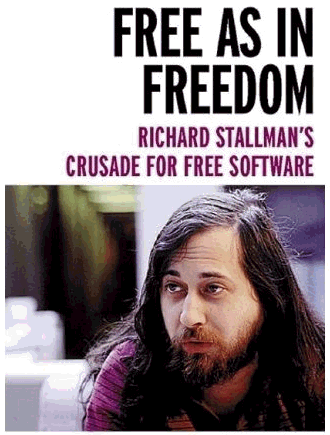
In this essay, I explore the questions - what is a hacker? what do we mean by hacker ethic? with reference to Bryan Pfaffenberger's article "The social meaning of the personal computer : or, why the personal computer revolution was no revolution", Sherry Turkle's book "The second self" and the Discovery channel documentary "The history of hacking". Various aspects of hacking are discussed through the example of one of the greatest ethical hackers of 20th century, Richard Stallman.
What is a hacker?
The Jargon file, a collection of hacker slang derived from technical cultures like MIT AI lab, defines a hacker as "A person who enjoys exploring the details of programmable systems and stretching their capabilities, as opposed to most users, who prefer to learn only the minimum necessary."
Hackers that use their skills for good are called as "white hat" hackers. these white hats often work as certified "Ethical hackers", hired by companies to test the integrity of their system.
We explore the culture of these white hat hackers and their hacker ethic through a view of life of Richard Stallman, one of the top 5 biggest white hat hackers ever existed.
Motivation behind hacking
Captain Crunch, arguably the first "hacker" summarizes his motives beautifully in the following statement
Stallman's crusade for software liberation started with a printer. At the MIT lab, he and other hackers were allowed to modify the code of printer so that they sent convenient alert messages. However, a new printer came along - one that they were not allowed to modify. It was located away from the lab and the absence of alerts was a huge inconvenience. It was the point that he was "convinced... of the ethical need to require free software."
Hackers and the society
As Sherry Turkle points out, hackers are closer to the computer than people. They are shy and inarticulate - trapped in the quest for control and mastery with the computers as their medium. Hackers tend to prefer relationships with computers than with humans. A major reason being computers can be "mold to their desires" - a world far less threatening and more rewarding than the world of conventional relations.
Hackers find their true friend, soulmate in the computer. Computers provide refuce to their loneliness. Stallman is no exception. Text editor is program with which hackers spend most of their time. Stallman made a text editor which had a feature called "the doctor". The doctor was a program with which one could chat and the doctor would answer them intelligently. What a cure for loneliness!
Hacker ethics
Hacker's obsession with computing leads to impatience and intolerance towards anything else that may come in the way. Following are some important beliefs in hacker ethics, as codified by Stephen Levy.
Stallman dedicated his life for freedom of software and information. He came up with the revolutionary concept of "copyleft". IT ensures that information required to modify/improve the program is always freely available.
Conclusion
Although hackers tend to be isolated, they have made a great impact on the society - a positive one in case of white hat hackers. Naming of an asteriod after Stallman testifies his impact on the society.
Referecnes
In this essay, I explore the questions - what is a hacker? what do we mean by hacker ethic? with reference to Bryan Pfaffenberger's article "The social meaning of the personal computer : or, why the personal computer revolution was no revolution", Sherry Turkle's book "The second self" and the Discovery channel documentary "The history of hacking". Various aspects of hacking are discussed through the example of one of the greatest ethical hackers of 20th century, Richard Stallman.
What is a hacker?
The Jargon file, a collection of hacker slang derived from technical cultures like MIT AI lab, defines a hacker as "A person who enjoys exploring the details of programmable systems and stretching their capabilities, as opposed to most users, who prefer to learn only the minimum necessary."
Hackers that use their skills for good are called as "white hat" hackers. these white hats often work as certified "Ethical hackers", hired by companies to test the integrity of their system.
We explore the culture of these white hat hackers and their hacker ethic through a view of life of Richard Stallman, one of the top 5 biggest white hat hackers ever existed.
Motivation behind hacking
Captain Crunch, arguably the first "hacker" summarizes his motives beautifully in the following statement
"It's (the phone network) a beautiful system, you know. I want to work for her. I want to help her get rid of her flaws and become perfect."The idea of looking at the machine not as a means to end, but the end itself, originated by phone phreaks, more or less remains the central idea for computer hackers too.
Stallman's crusade for software liberation started with a printer. At the MIT lab, he and other hackers were allowed to modify the code of printer so that they sent convenient alert messages. However, a new printer came along - one that they were not allowed to modify. It was located away from the lab and the absence of alerts was a huge inconvenience. It was the point that he was "convinced... of the ethical need to require free software."
Hackers and the society
As Sherry Turkle points out, hackers are closer to the computer than people. They are shy and inarticulate - trapped in the quest for control and mastery with the computers as their medium. Hackers tend to prefer relationships with computers than with humans. A major reason being computers can be "mold to their desires" - a world far less threatening and more rewarding than the world of conventional relations.
Hackers find their true friend, soulmate in the computer. Computers provide refuce to their loneliness. Stallman is no exception. Text editor is program with which hackers spend most of their time. Stallman made a text editor which had a feature called "the doctor". The doctor was a program with which one could chat and the doctor would answer them intelligently. What a cure for loneliness!
Hacker ethics
Hacker's obsession with computing leads to impatience and intolerance towards anything else that may come in the way. Following are some important beliefs in hacker ethics, as codified by Stephen Levy.
- Access to computers should be unlimited and free.
- All information should be free.
- Mistrust the authority - promote decentralization.
Stallman dedicated his life for freedom of software and information. He came up with the revolutionary concept of "copyleft". IT ensures that information required to modify/improve the program is always freely available.
Conclusion
Although hackers tend to be isolated, they have made a great impact on the society - a positive one in case of white hat hackers. Naming of an asteriod after Stallman testifies his impact on the society.
Referecnes
- The second self - Sherry Turkle
- The social meaning of the personal computer - Bryan Pfaffenberger
- Wikipedia
- Richard Stallman biography
- List of 10 greatest hackers : an article on www.itsecurity.com
Tuesday, April 12, 2011
Who is a Hacker?
Introduction
There is no one way to define a hacker. Hackers come in many varieties – Phone Phreakers, Network Hackers, Media Hackers, Hardware Hacker and so on. And while there is no one easy way to define a Hacker, one can observe, from their want for attention and their relentless disobedience of authority in their own pursuit of knowledge, that they are somewhat like a child – this analogy while not covering all the aspects of what it means to be a hacker, encompasses the essential aspects – Hackers ‘Do’ because they are curious, not for a cause, not for monetary gain and sometimes in this pursuit, they get caught as illustrated by Mitnick’s example. When Hackers do things, they bent the technology around them to achieve their goals, they never give into the constraints posed by the technology – infact one might go so far as to say that hackers really are just constraint benders and removers – and consequently are the Teasers at the Margin of technology. So while Hackers wield so much power in their hands (which arises from their juxtaposed tendencies to understand and control while also to be able to let loose and explore) , and when hacking culture gained momentum beginning with 1960s, a new set of ethical principles and a collective cultural view of society or at least how it should be arose in the eyes of the hacker leading to a established hacker subculture.
Ethics of the Hacker (?)
The Hacker ethic is essential to the idea of a Hacker Culture. It comprises of the set of rules and principles one must stick to in any situation, it is not a separate morality in itself but a product of the hacker’s world view. The product borne out of their mechanistic view of the universe and their thirst for understanding and conquering the “machine” - be it computer or telephone or in some cases even other people.

Take for example Kevin Mitnick, one of the famous 20th century hackers, even though he was accessing proprietary information, he always claimed to do so for the joy of it - to know that he could do it, and when he kept this information, it was not for monetary gain but as a trophy to him, a proof of his abilities and the understanding he had in navigating the system. This highlights another important characteristic of the hacker, their need to feel that they can also influence control on the state of things - in Mitnick’s case, computer network technology, in other words, they feel a need for a decentralised scheme of things. Thus, Hacking is a means for them of ensuring that their world is not controlled solely by external factors. Another, major hacker is Richard Stallmanm, the founder of the free software movement, he became so engrossed with developing and making free the fruits of computer programming that he started the OpenSource movement which helped boost the hacker ideal of sharing and freeness of information. This too is another essential quality of hacker ethic - the idea of freeware and imbuing freedom of use to one’s creative products.
In Conclusion
Often mistaken as hackers are the crackers who hack things not for the pleasure of understanding but maliciously with intent to injure and use the stolen information for illegitimate purposes, it must be noted that they are not operating in the true spirit of hacking as hacking seeks not to overthrow and control everyone but in it’s truest sense to try to embrace and understand technology and modify it for the better. The hacker is that mischievous and curious child near the sandbox in the playground not the Fist flinging bully near the swings.
Bibliography
1) Wikipedia: Hacker Ethic, Hacker Culture, Richard Stallman, Kevin Mitnick
2) Sherry Turkle, Hackers: Loving the Machine for Itself
3) Pfaffenberger, The Social meaning of the Personal Computer
Barath
The Emerging Preprocessing Directive
Introduction
The subjection of routine tasks to mechanical means gained thrust in the industrial age where automation became the norm of the factory production. Although, automation initially was detested by workers for slashing their jobs (as can be seen in the agitations of the Luddites), these feelings reduced as the Industrial Revolution marched on due to the migration of skilled workers into other avenues of employment. Thus, automation even though faced with initial resistance, achieved its ultimate aim of making easy the processes of industry. With the advent of Computers post-WWII, it was only time before information and data were also automated. This too happened, with some resistance, but it has not been quite successful as it is yet to reach full potential, for while it automated data, it failed to informate it. I would like to discuss the essential difference between these two and the significance this understanding plays in contemporary life with help of an example.
The Difference and its Challenge
Take the instance discussed in Alan November’s work Empowering Students with Technology of Schools where academic data records of students have been automated i.e. the schools have computerized the Grade Records of each Student and have made the calculation of functions based on these (say average, etc,.) automatic. This does automate the process of the making the Report Card of Students and hence is a definite improvement as it solves the problem with less effort than traditionally required but real informating this Data means to use it to give “more” information, achieve more control and make available more access than would be other not be possible – An explosion of new interactions and derivations with minimal effort enabled by the automating driving the informating. For example, with this computerization, the school could make the Grade card accessible to parents as an online Web-Grade Card which helps in tracking their Ward’s progress or they could schedule it to send emails to parents when their wards perform poorly or commend them when they do well. It could be used to inform the students themselves about the trend in previous years for electives chosen and how students before them performed, it could be used to help them find specific areas they need to concentrate on given their pursuit for higher education or it could even simply list the number of hours they need to put in to study based on their current score (possibly depending on a survey from previous batches of students). As can be easily realized, the variety of possibilities when one shuns the veil of automating and explores the possibility of informating are vast (even with such a small application as school student academic records) It only takes a little application, some insight and a little drive to achieve more than that offered by the plain platter of automation.
In Conclusion
As Technologists claim, we are in the Information Age and we need to take advantage of the possibilities offered by informating. The Main struggle against this currently I feel is the lack of understanding of the possibility offered by technology like the computer – most people do not know fully how to operate and take advantage of their computer, they are more than content with it for using it in sending, receiving email and surfing the web. This situation has to be remedied, at least by the next generation, where computer literacy should gain the foremost significance in education (both in spread and in depth) and an understanding of the essential difference people can make with computers (essentially a shift in people’s perspective from ‘computer as a tool for data crunching’ to ‘computer as a information deriver’), a complete integration of technology into education and work. With the realization of the vast possibilities of informating over plain automating, I feel confident that society will move towards this new information horizon and as we move through this stage of the information revolution - which is similar to what the initial stages of industrial revolution was for automating, I hope we will reach a time when informating, whose impact is currently only being realized in contemporary work life, will become an activity as mundane as automating - a preprocessing for newer and better analytics to come.
bibliography:
1) Alan November's Empowering Students with Technology
2)http://www.doug-johnson.com/dougwri/informate-not-automate.html
Barath A
What is the information panopticon? : Discussion with reference to the use of ICT in organization of work
Introduction
The brainchild of 18th century English philosopher Jeremy Bentham, panopticon was an architectural innovation designed to lead to safe, humane prisons. The human tendency to think that, "every thing you do is right, until you get caught!" is what Bentham sought to curb using panopticon. The panopticon was engineered in such a way that, from a central tower, every prisoner in any cell could be observed., without the possibility of being observed by the prisoner.
The central goal of panopticon was to achieve control through isolation and possibility of constant surveillance. The very thought of "somebody is watching us", in many cases, is sufficient to keep the behavior under control, regardless of the fact that at the moment, nobody might be observing. Surprisingly, this idea was far more generic and was a good one for even schools, hospitals etc.
The information panopticon
Realizing that in the modern, information centric world, control no longer requires physical domination over body, but can be achieved through isolation and constant possibility of observation, Michel Foucalt applied the idea of panopticon as a metaphor for the oppressive use of information in the modern disciplinary society.
To gain control, all that is needed is complete knowledge and observation. In the information panopticon, we are seen without seeing the observers. The information is available without the knowledge of the subject. With the presence of such a panopticon, people need to regulate their own behavior to escape the constant threat of detection.
The information panopticon is both literal and metaphorical. It manifests itself through public CCTV cameras, electronic monitoring of workers, face recognition and many more.
Information panopticon in use
Soon after it was conceptualized, the idea was put into use. With ever increasing mechanization and automation, factory setting was a perfect place for a panopticon. Its modest roots can be traced back to the days when workers needed to swap their "punch cards" through a slot in order to notify their arrival and departure. This simple setting, automatically did the job of keeping track of number of workers, their arrival and departure times automatically. This is good example of passive information collection.
With the advent of internet, teh world has become a global village, and information sharehouse. But simultaneously, it became a source of distraction, unproductive wastage of time and money, if not used with control. The idea of information panopticon is central to organization of work in any modern corporation/organization/company whose employees work on computers. In this case, the panopticon is even more powerful by rendering itself invisible. With the use of advanced software, all the employees are being monitored in real time for their online activities. Websites which are found to distract the employees and waste a lot of productive time are being banned based on the collection by the panopticon.
Conclusion
The notion of information panopticon has a great role to play in the moders information centric society. But this brings forth the question of integrity of those who are in power, the "observers" of the panopticon. The question "how much is too much?" must be addressed as the internet is being overpowered with services like google and facebook who are the bare essentials, information panopticons with vested, commercial interests.
Limits are already being crossed. Facebook now decides whos is my best friend and who I must interact iwth. Google knows everything about me from how I plan my travel to what kind of information content is "relevant" to me.
I conclude with an open question "who will observe the observers?"
Reference
The brainchild of 18th century English philosopher Jeremy Bentham, panopticon was an architectural innovation designed to lead to safe, humane prisons. The human tendency to think that, "every thing you do is right, until you get caught!" is what Bentham sought to curb using panopticon. The panopticon was engineered in such a way that, from a central tower, every prisoner in any cell could be observed., without the possibility of being observed by the prisoner.
The central goal of panopticon was to achieve control through isolation and possibility of constant surveillance. The very thought of "somebody is watching us", in many cases, is sufficient to keep the behavior under control, regardless of the fact that at the moment, nobody might be observing. Surprisingly, this idea was far more generic and was a good one for even schools, hospitals etc.
The information panopticon
Realizing that in the modern, information centric world, control no longer requires physical domination over body, but can be achieved through isolation and constant possibility of observation, Michel Foucalt applied the idea of panopticon as a metaphor for the oppressive use of information in the modern disciplinary society.
To gain control, all that is needed is complete knowledge and observation. In the information panopticon, we are seen without seeing the observers. The information is available without the knowledge of the subject. With the presence of such a panopticon, people need to regulate their own behavior to escape the constant threat of detection.
The information panopticon is both literal and metaphorical. It manifests itself through public CCTV cameras, electronic monitoring of workers, face recognition and many more.
Information panopticon in use
Soon after it was conceptualized, the idea was put into use. With ever increasing mechanization and automation, factory setting was a perfect place for a panopticon. Its modest roots can be traced back to the days when workers needed to swap their "punch cards" through a slot in order to notify their arrival and departure. This simple setting, automatically did the job of keeping track of number of workers, their arrival and departure times automatically. This is good example of passive information collection.
With the advent of internet, teh world has become a global village, and information sharehouse. But simultaneously, it became a source of distraction, unproductive wastage of time and money, if not used with control. The idea of information panopticon is central to organization of work in any modern corporation/organization/company whose employees work on computers. In this case, the panopticon is even more powerful by rendering itself invisible. With the use of advanced software, all the employees are being monitored in real time for their online activities. Websites which are found to distract the employees and waste a lot of productive time are being banned based on the collection by the panopticon.
Conclusion
The notion of information panopticon has a great role to play in the moders information centric society. But this brings forth the question of integrity of those who are in power, the "observers" of the panopticon. The question "how much is too much?" must be addressed as the internet is being overpowered with services like google and facebook who are the bare essentials, information panopticons with vested, commercial interests.
Limits are already being crossed. Facebook now decides whos is my best friend and who I must interact iwth. Google knows everything about me from how I plan my travel to what kind of information content is "relevant" to me.
I conclude with an open question "who will observe the observers?"
Reference
- The virtual panopticon - David Engberg
- Surveillance 2.0 : The "information panopticon" and education - Larry Kuhen
Friday, April 8, 2011
The Information Panopticon
It was very early on that Man realised that any organized work or activity requires some sort of supervision. It is for the sake of supervision that there are hierarchies in every organization. Supervision was even built into the architecture of buildings like schools, banks, prisons and hospitals; the supervising authority had an overview or a “panopticon” of the subjects, by which they could examine the activity and status of each and every one of the subjects. This is carried on to the present in the form of the Information Panopticon, where we are constantly being supervised with the help of technology.
Michel Foucault, in his book Discipline and Punish: The Birth of the Prison gave examples of this kind of architecture. A prison, for example, had a central tower in which a guard was housed. The tower was surrounded by the cells. Hence, the guards could easily supervise the inmates. Even in many schools, the classrooms are arranged in a circle for easy supervision. Inside the classrooms, the teacher stands on a raised platform and can monitor students. In hospitals, all the wards would be transparent so that the status of the patient could be checked on any time.

Today, supervision by architecture has been replaced by supervision by computers. As much of our work today involves some kind of computer operation like running a program, creating a document or sending an email, this supervision becomes easy. The time stamp on our work automatically tells the boss when the job was done. A striking observation of this is that the supervising entity cannot be negotiated with or pleaded with. As always, the replacement of man by machine brings in some kind of rigidity. The machine simply does what it is programmed to do; neither does it need to negotiate with the subordinates nor does it need to listen to their excuses. Thus, the information panopticon has this impact on our work lives. Let us take for example the computerisation of British banking industry in the 70’s and early 80’s.
In British banking the traditional mode of training prior to computerization was based on a master-apprentice model, according to Steve Smith (1989). Employment began at age 15 or 16, and one then rose level by level through a pyramidal hierarchy. Ultimately, with luck and aptitude, any employee could hope to become manager of a branch bank or even a general manager at corporate headquarters. Along with this career structure went an ethos of employee flexibility. Clerks had a relatively wide range of skills, allowing them to shift from task to task during the banking day. British bankers installed computers as part of a general plan to move away from the craft-apprenticeship model toward a rationalized industrial production model. Computers facilitated, for example, progressive specialization of tasks and automation of a great deal of work once done by hand. Along with this specialization went a deliberate restructuring of career paths.
Thus, we can see that the use information panopticon in our work lives can bring about radical changes not only to the structure of the work system but also to the skill set and the attitude of the individual workers. But we can safely say that this change is for the better since it leads to greater efficiency and productivity.
By Pranav R Kamat
References:
Michel Foucault, “Discipline and Punish: The Birth of the Prison”
Subscribe to:
Posts (Atom)